
Q4 Short Term Rental Strategy: Minimum Stays & Gaps

From Saturday, October 24 through Sunday, November 1, Bridgestone Arena has an event every single night but one.
Matt Rife. Predators vs. Avalanche. Predators vs. Islanders. SOMBR. Predators vs. Capitals. Zach Top. Predators vs. Lightning on Halloween afternoon. Three Days Grace to close it out. Add the Titans hosting Cleveland at noon on the 25th and Nashville SC at GEODIS mid-week, and you have nine days of downtown demand.
The exception is Monday, October 26. Nothing at the arena. That single dead night is where a Q4 short term rental strategy either holds or quietly leaks money, and most DIY hosts never see it happen.
Here's the part worth your attention: the leak usually isn't your nightly rate. It's that your open nights aren't actually for sale. A calendar can be wide open and still unbookable, because Nashville Airbnb minimum stay rules, prep time, and arrival restrictions can block dates no guest ever sees.
This isn't a "raise your prices for the big weekend" article. It's the mechanics of how stay restrictions and event demand interact, what an orphan gap actually is, and the test that tells you in 60 seconds whether your calendar is working.
Why Q4 Pricing and Minimum Stays Must Work Together
Most owners treat these as two separate dials. Pricing software handles rate, and minimum stay is something you set once in Airbnb and forget.
That's the error. Rate determines what a booking is worth. Minimum stay determines whether the booking can happen at all.
Discounting a two-night opening does nothing if a three-night minimum still blocks it. You can drop the price every day for a week and watch zero bookings arrive, because no guest searching those dates is ever shown your listing.
Check eligibility first. Decide price second. That order matters more than any single rate decision you'll make this quarter.
And one framing correction before we go further, because you'll see it everywhere: Q4 does not automatically make or break your annual return. Nashville's demand runs heavy from spring through autumn. October is a strong month with an unusually dense event calendar, not a referendum on the year.
What an Orphan Gap Actually Looks Like
You've probably read that a one-night Sunday booking "costs you the whole following week." That's not how it works, and the oversimplification leads people to reject perfectly good revenue.
Here's the real mechanism. A gap becomes a problem when the space left between reservations can't satisfy your own booking restrictions.
Work through the actual calendar:
- Reservation A checks out Monday, October 26
- Reservation B checks in Friday, October 30 (Zach Top at Bridgestone)
- Available: Monday, Tuesday, Wednesday, Thursday. Four nights.
Four nights is a sellable block. Now a guest books Tuesday, October 27 only.
- Monday is now a 1-night gap
- Wednesday to Thursday is now a 2-night gap
If you're running a default three-night minimum, neither remaining segment can be booked by anyone. You went from four sellable nights to one booked night and three stranded ones, and nothing on your calendar looks wrong.
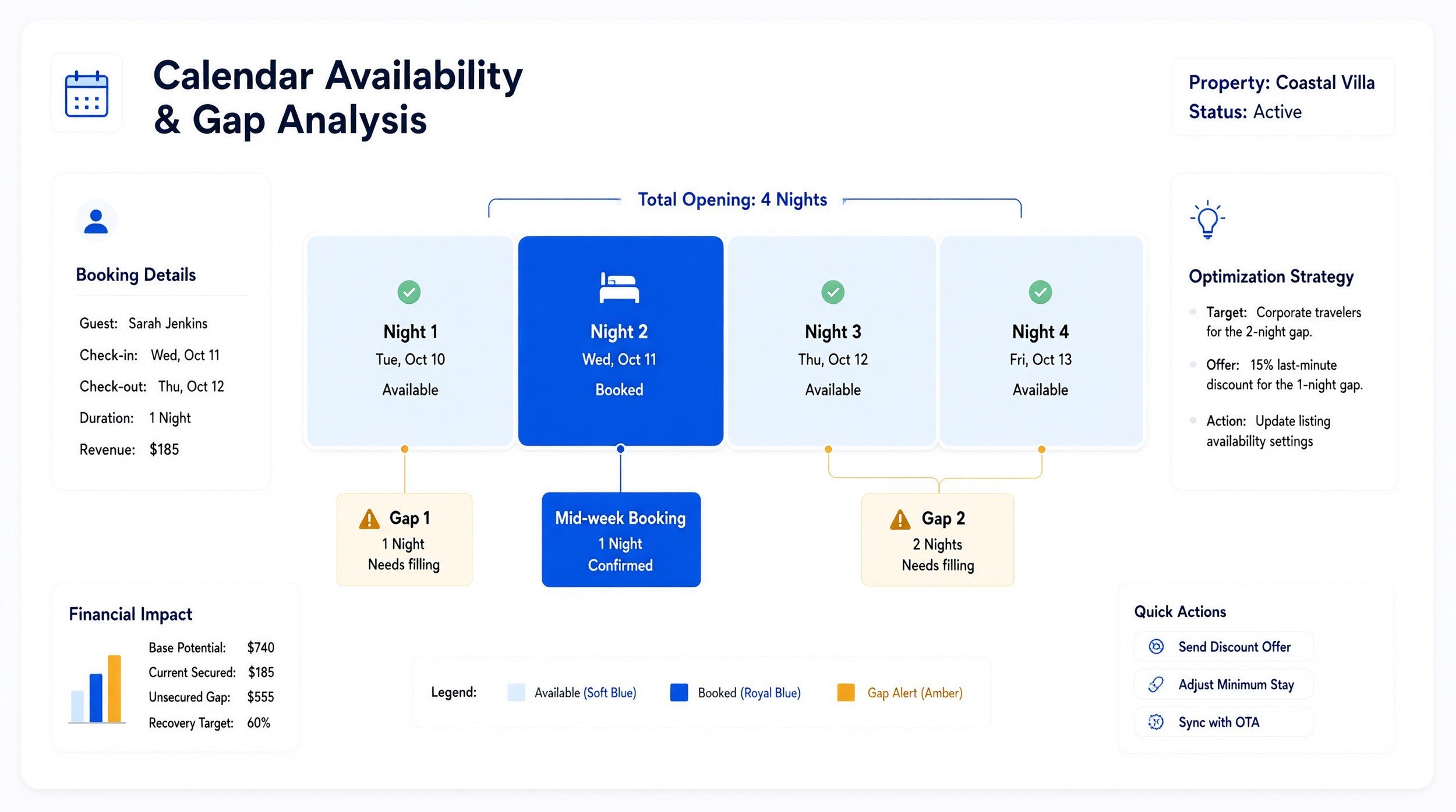
Three things that example proves:
- The problem is where the booking landed, not that it was short
- The Tuesday booking did not destroy the week on its own, your restriction did
- Those remaining nights are recoverable with the right gap exceptions configured
Nashville's Real October Calendar: Why Your Weekdays Aren't Dead
This is where most Nashville event-pricing advice falls apart. It names the two obvious weekends and treats everything between them as filler. Verified from the venues' own listings:
- Oct 24 (Sat): Matt Rife, Stay Golden Tour, Bridgestone, 8:00 PM (doors 6:30)
- Oct 25 (Sun): Titans vs. Browns, Nissan Stadium, noon CDT
- Oct 25 (Sun): Predators vs. Avalanche, Bridgestone, 7:00 PM
- Oct 26 (Mon): No arena event: the gap night
- Oct 27 (Tue): Predators vs. Islanders, Bridgestone, 7:00 PM
- Oct 28 (Wed): SOMBR, You Are The Reason Tour, Bridgestone, 7:00 PM (doors 5:30)
- Oct 29 (Thu): Predators vs. Capitals, Bridgestone, 7:00 PM
- Oct 30 (Fri): Zach Top w/ Lukas Nelson, Bridgestone, 8:00 PM (doors 6:30)
- Oct 31 (Sat): Predators vs. Lightning, Bridgestone, 1:00 PM + Halloween
- Nov 1 (Sun): Three Days Grace, Alienation Tour, Bridgestone
Start times as listed by Bridgestone Arena and the Tennessee Titans, retrieved October 23, 2026. Confirm with the venue before travel.
Tuesday, Wednesday and Thursday the 27th through the 29th each have a 7:00 PM downtown arena event. Those are not throwaway nights you hold hostage waiting for a long stay. They're one-night-demand nights.
Monday, October 26 is the only genuinely soft night in a nine-day stretch. That is the night an orphan gap actually hurts, and it's exactly the night a Sunday-only booking strands.
Two corrections worth making, because both are circulating: Zach Top plays Friday, October 30 only, not a two-night Halloween run. And the Halloween Predators game starts at 1:00 PM, not 2:00. An afternoon puck drop changes arrival and departure behavior substantially.
October 25 vs. Halloween Weekend: Two Different Demand Windows
Treating these as one "busy stretch" is how owners mis-set the whole period.
Sunday, October 25: the stacked sports day. Noon kickoff at Nissan, 7:00 PM puck drop at Bridgestone. A Sunday-only booking here can be the right answer, provided it doesn't strand Monday the 26th behind a restriction, and provided your turnover team can actually service it.
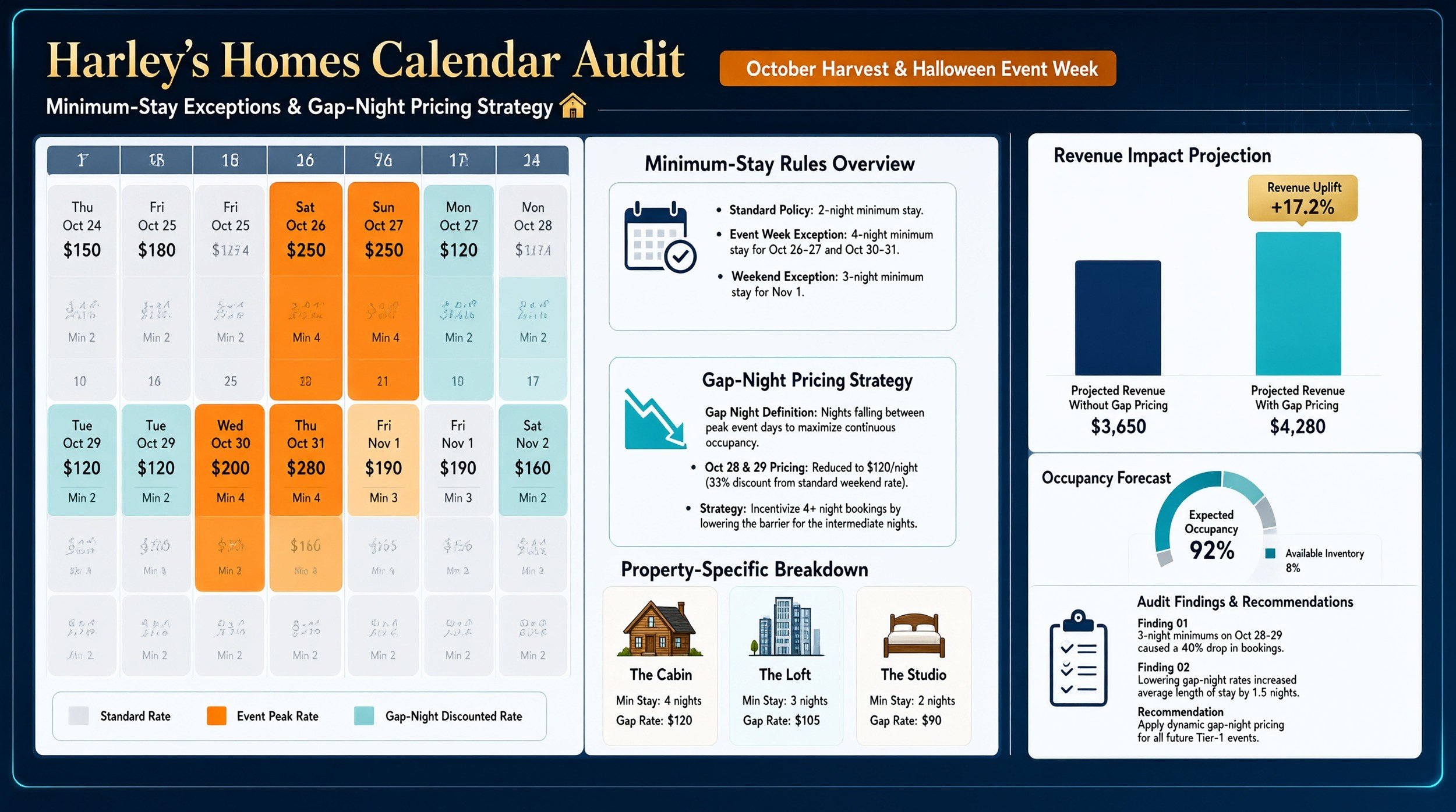
Friday to Saturday, October 30 to 31: the concert and Halloween window. Zach Top Friday at 8:00 PM. Predators at 1:00 PM Saturday. Halloween all day Saturday. A two-night Friday to Saturday minimum is a reasonable starting hypothesis here, not an automatic optimum.
Monday to Thursday in between: three of those four nights have arena events. Price and gate them individually. Do not hold Monday through Thursday for an imagined week-long Halloween stay that the booking data doesn't support.
What Nashville's Minimum-Stay Data Actually Says
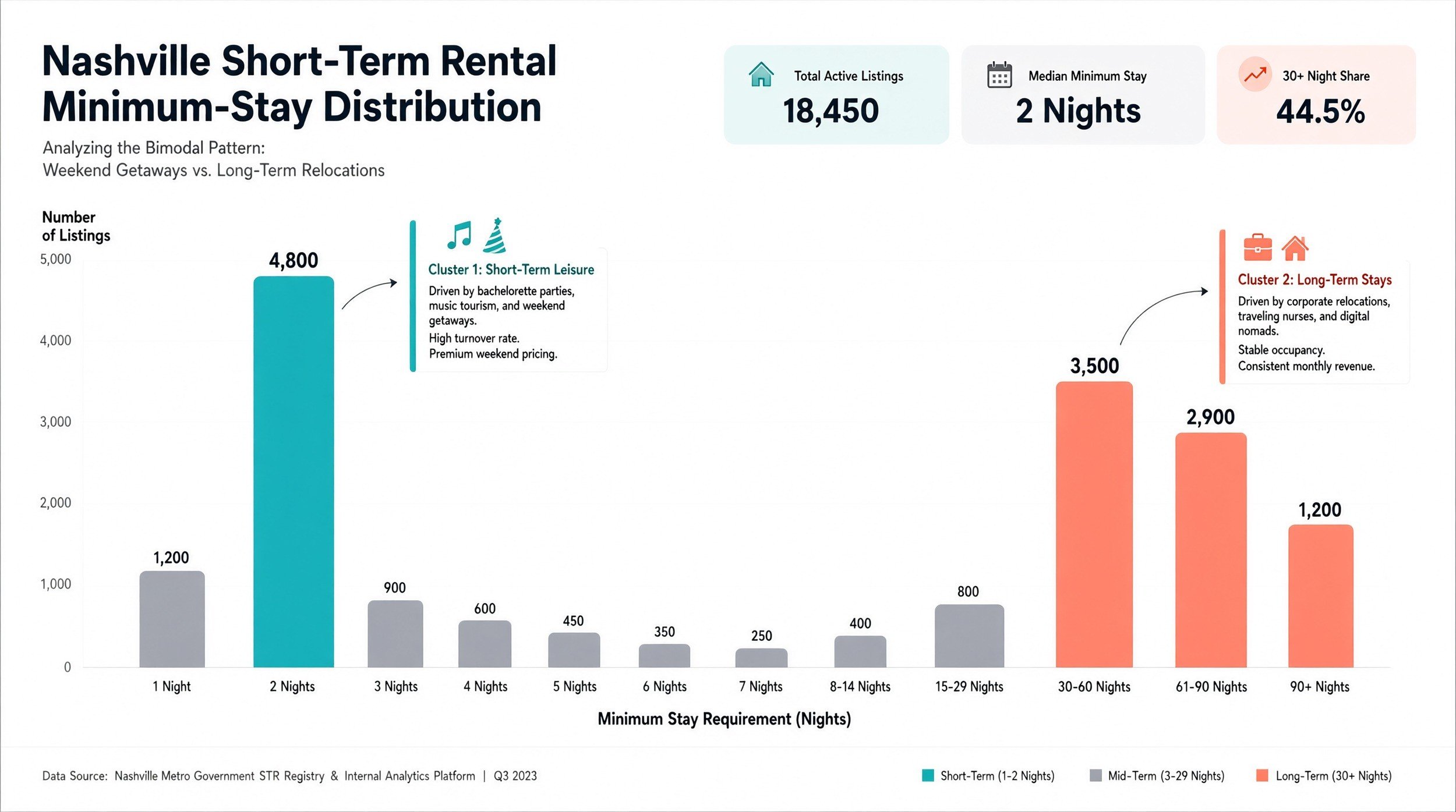
AirDNA's public Nashville overview reports the distribution of displayed minimum stays: 2-night minimum at 43.3%, 3-night at 14.3%, 30-plus-night at 39.3%, and 1-night at 0.3%.
Most people would read that bottom number and conclude almost nobody accepts one-night stays. That conclusion is wrong, and it's an expensive mistake. Nearly 40% of those listings sit at a 30-plus-night minimum, mid-term and long-term rentals, a completely different business. And displayed minimum is not the operative minimum. A listing showing a 2-night default can still run dynamic exceptions that release one-night stays into specific gaps.
Two nights is the common Nashville default, so a two-night minimum makes you ordinary, not optimized. The edge isn't in the default. It's in the exceptions.
Why Your Empty Nights Might Not Be For Sale
Minimum nights are not the only thing that blocks a date. Airbnb also lets preparation time, advance notice, and restricted check-in or check-out days make an open night invisible to a search. So a host sees vacancy, drops the rate, sees nothing happen, drops it again. The rate was never the problem. The date was never purchasable.
The 60-second test: open a private browser window. Search your own listing for the exact arrival and departure dates you're trying to sell. Run it three times: a one-night stay, a two-night stay, and the longer stay you're hoping to protect. Note which ones return your listing and which don't.
After any change, re-run the three searches and write down which rule produced which result. Restrictions can be set in Airbnb directly, in your PMS, or in your pricing tool, and when they disagree, the behavior isn't always obvious.
The Net-Revenue Test for Short Bookings
Stop asking "should I allow one-night stays." Ask what a specific booking actually contributes: accommodation revenue plus cleaning fee collected, minus channel and payment fees, minus actual turnover cost, minus incremental supplies and utilities.
A one-night booking at a strong rate on Tuesday, October 27 (a Predators night) with a turnover team that can service it and a Monday your restrictions can still sell, is good business. The same booking placed where it strands three nights behind a three-night minimum is not. Same booking. Same rate. Opposite answer.
Protect Longer Stays Early, Release Selectively Later
Far out from a high-demand date, protecting multi-night stays is defensible. Close to arrival, the calculus inverts. A rigid holiday minimum that made sense two months ago now blocks viable shorter trips while your nights expire worthless.
Build a review-and-release process: how many nights remain unsold and where are they positioned? How is pace running against the same window last year? What's the real turnover cost of accepting a short stay on this date? Can operations actually deliver it without compromising the booking next door?
The Playlist Properties Advantage
Everyone has the same pricing software. PriceLabs, Beyond, Wheelhouse: they're available to you for roughly the price of a dinner. The software is not the moat. What the software can't do is decide.
We review what can book, not just what each night costs. Restriction audits on every property, with the actual guest-search test run after changes. We own our turnover: Music City Spotless is ours, not a subcontractor. And we watch the calendar forward: the October 24 to November 1 event stack was on our radar in August.
Ready to find out what your calendar is actually worth this Q4? Schedule a free 15-minute call.


